Advantages and difficulties in the process of teaching Vietnamese to foreigners

Pham Thanh Binh · 3 min read
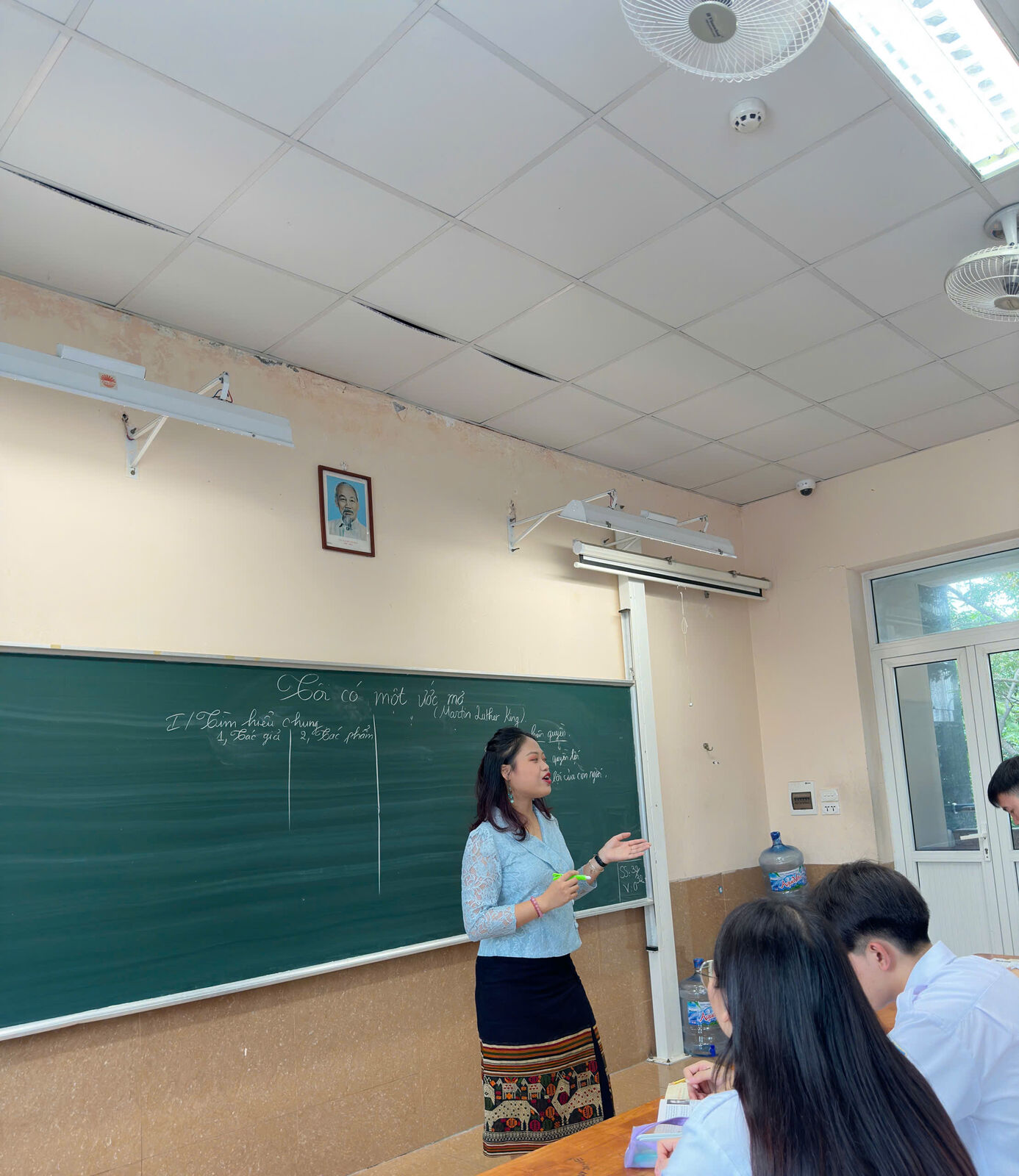
Teaching Vietnamese to foreigners should be regarded as teaching a foreign language. In that light, the teacher needs to identify clearly the advantages already available and the difficulties likely to arise in order to make a concrete teaching plan.
First of all, the advantage is that textbooks for teaching Vietnamese to foreigners have by now become far richer and more varied than before. The community of teachers of Vietnamese to foreigners, and of researchers of this activity and field, is growing and expanding both in Vietnam and abroad. As a result, I and many other teachers have more opportunities to learn teaching methods and to share high-quality learning materials. Notably, as more and more learners take part in in-person and online teaching models, the experiences shared and the perspectives on the situation are also broadening, so that teachers can assess learners’ abilities objectively. Furthermore, my time teaching many foreign students has helped me realise that most learners are afraid of making mistakes and reluctant to practise, so their speaking skills are still weak. Pronouncing sounds unclearly, putting words in the wrong order in a sentence, choosing words that do not fit the meaning, and so on, are the errors I have identified, and I have built suitable types of exercises to help students overcome them and improve.
Next, difficulties are unavoidable, and teachers need to prepare themselves mentally to face and overcome them. First, when teaching a foreign language, having an intermediary language that teacher and learners can use to exchange ideas and explain things is an advantage. However, in a Vietnamese class for foreigners, each person comes from a different country, so the teacher has to prepare ways of conveying ideas in the opposite situation: with no intermediary language between teacher and learners. Therefore, I and many other teachers have had to turn to other vivid, visual means and forms of explanation and illustration, such as pictures, film clips, the performing arts, and so on. We therefore have to keep being creative in order to get the message across. In my view, vocabulary-building topics that are abstract, such as emotions, or that belong to the specialised language of a school subject, are a challenge. Finding words in another language that fully express Vietnamese words while keeping their true nuance is always difficult. Moreover, the system of reduplicative words (từ láy) in Vietnamese is very distinctive, and teachers need to be skilful in explaining them so that their meaning is conveyed fully and completely. Finally, many foreign students have difficulties with the parts of the vocal apparatus involved in articulation, which also becomes a barrier when teachers guide them in practising pronunciation.
Thus, advantages and difficulties always exist side by side, requiring me and my colleagues to be responsible, patient and passionate on the path of teaching Vietnamese to foreigners. For me, every presentation, paragraph or letter written in Vietnamese by my foreign students is like a precious gift from this beautiful journey. I am truly grateful to the international students who have chosen to study and explore Vietnamese, giving me and many of my colleagues one more opportunity to bring Vietnamese culture to more friends around the world. Thank you sincerely!